General
Around 500 million years ago, during the Cambrian Period, most of
the British Isles, was submerged beneath a sea but the big surprise is that it was located
near present day Antarctica, off the coast of a vast continent known as Gondwana.
The crust of the Earth, around 30km thick, floats on a mantle of molten rock called magma.
It is split into a number of parts called Tectonic Plates.
Over millions of years these plates have shifted to their current positions.
When these plates collide the tectonic plates becomes crumpled forming mountains.
The Himalayas and Alps were formed in this way.
If they are moving alongside each other in opposite directions they may stick leading to stress.
At some point they will suddenly move, relieving this stress causing an earthquake.
One of the most well known being the San Andreas Fault near San Francisco.
Volcanoes also occur at points where tectonic plates are colliding or pulling apart.
The Pacific Ring of Fire is an example of collision wheras the Mid Atlantic Ridge under the ocean
is caused by the plates pulling apart. They can also occur in areas where the crust is thinner, and the temperature of
the molten rock mantle is higher. This happens in places such as Hawaii and Iceland.
|
 |
Warwickshire
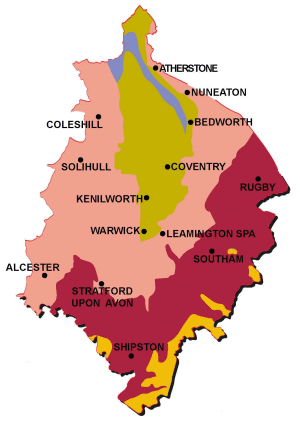
Warwickshire has one of the most varied selections of rocks in the country. It spans over 600 million years from the depths of the Precambrian period, with violent volcanic eruptions, through to the much more recent sands and gravels which formed during the Pleistocene ice age, whose latest phase was only 10,000 years ago.
The rocks vary from hard lavas, sandstones of many colours, grey and honey coloured limestones, coal, and soft silts, clays and gravels. They reflect environmental conditions which at various times have been desert, marine, equatorial and arctic. The rock types also influence the scenery with, for example, harder limestones and ironstones. forming high ground such as Edge Hill in the of south Warwickshire. In rural areas the building materials of cottages and farms often reveal the nature of the local rocks.
The county boasts a superb variety of fossils from Cambrian triolobites to the huge range of Jurassic invertebrates. Unique reptile and amphibian bones and footprints from the Triassic are of special interest, while marine reptile remains from the Lower Jurassic, such as the Wilmcote plesiosaur, are equally spectacular.
Many rocks are commercially valuable, with quarries and mines being dug to extract them. Some rocks have been used for building stones and others as sources of metals like iron and manganese. Coal was exploited as fuel, clays for pottery and brick making; limestone provides cement and the sands and gravels are sources of aggregate. The county has many abandoned quarries and today, these give us perfect opportunities to see the underlying geology.
|
 |
|